E-Machines

We are specialized in the development of electrical machines

Within the E-machines research group, our core competence lies in the development of new electrical machines for power-electronic mobility applications, which we realize for our industrial and research project partners. The development process starts right from the idea and concept phase and includes both the electromagnetic and thermal design. In addition, we create mechanical constructions and production-ready blueprints for our partners.

For the simulation, we use the standardized FEM software Ansys Maxwell and Motor-CAD for the electromagnetic design, as well as Ansys CFX and Fluent for the thermal design. The mechanical construction is carried out with the software Creo. Our models are simulated in a verifiable manner and constructed using a well-founded methodology. We create high-quality virtual models for electromagnetic and thermal functionality to make the results swiftly visible and easy to compare.

Design competence

Our portfolio ranges from the design to the prototypical realization of electric motors.

The picture on the left shows an example of our electromagnetic design.

© Xinjun Liu / Fraunhofer IISB
Optimization graph
© Thomas Richter / Fraunhofer IISB
Project example: 6-phase 175 kW electric motor for 800 V applications

We focus on electric motors with the highest system efficiency, which are based on electromagnetic, thermal and mechanical design and are developed particularly for automotive applications.

Our focus areas

  • Electromagnetic design for various topologies of electric motors, including permanent magnet synchronous machines, externally excited synchronous machines, and axial flux motors, etc.
  • Mechanical simulation for the realization of high-revving variants with CFRP (carbon fiber) or high-quality electrical sheets.
  • Thermal design for various cooling concepts for electric motors, such as water cooling systems, oil cooling for the winding head and direct cooling.
  • Mechanical construction for the assembly of the electric motor and the integration of the electric motor with the inverter in the system.
  • Fundamental research for electrical motors in different variants, e.g. multiphase electrical motors.

Fuel cell and aviation applications

We provide customized solutions for high rotational speeds and sensorless control.

The picture on the left shows our CAD design of the AMBER machine

© Xinjun Liu / Fraunhofer IISB
CAD design of the motor from the Dimension project
© Xinjun Liu / Fraunhofer IISB
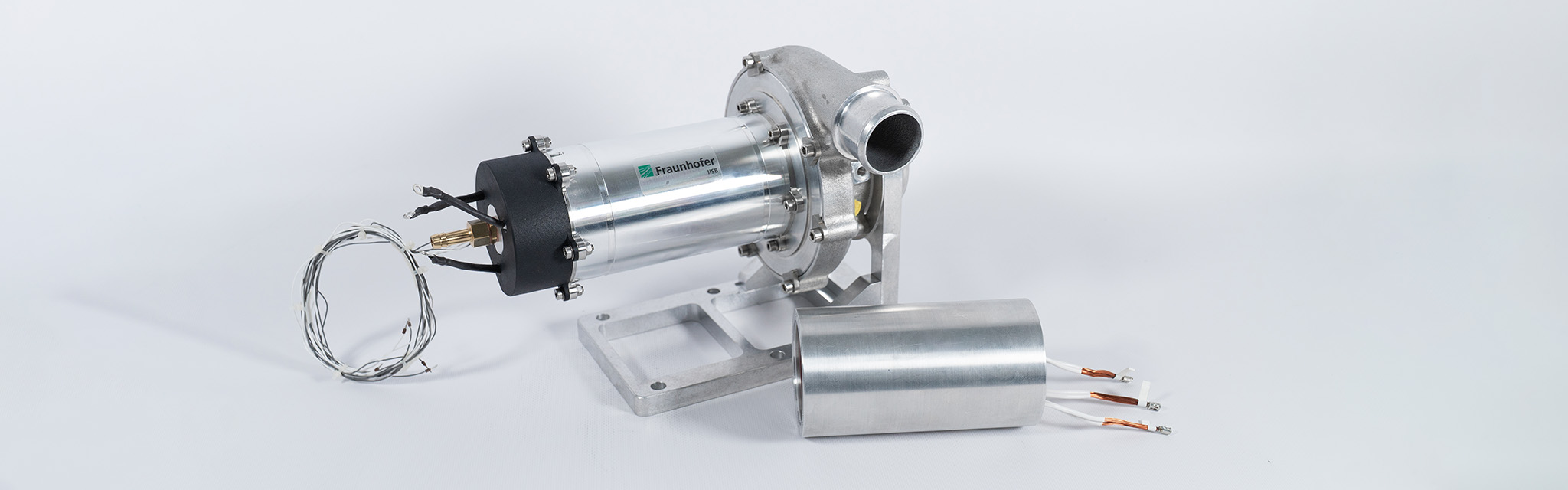
Electrical air compressor that has a maximum speed of 150,000 rpm and provides output power of up to 80 kW for fuel cell applications from the Habicht project

One example of our activities in fuel cell and aviation applications is our work in various projects:

Clean Aviation Project AMBER (InnovAtive DeMonstrator for hyBrid-Electric Regional Application): 

Here we concentrate on the development of an electric motor for traction applications. We achieve the highest power density in the electric motor through the electromagnetic, thermal and mechanical design using hairpin windings and innovative cooling concepts. 

Project Dimension (Digitalized & modular door architectures and systems for the integrated hull of tomorrow and beyond): 

Our contribution is the development of an electric motor as an actuator with maximum power density, which is integrated in a highly compact housing using lightweight construction technologies. Our development process covers everything from the specification phase to the realization of prototypes and validation on our motor test bench.

Fraunhofer PREPARE Project Habicht (High RPM electric drive for fuel cell and aviation applications): 

Our focus is on a high-speed electric machine as an air compressor for the fuel cell system, which achieves maximum power density through direct cooling in the stator and rotor cooling. Electrical air compressor that has a maximum speed of 150,000 rpm and provides output power of up to 80 kW for fuel cell applications. In collaboration with our Inverters group at the IISB, the electric air compressor was validated on a test bench with a GaN inverter.

System simulation

For maximum system efficiency, we consider simulation data from the inverter when designing our electric motor.

Our close cooperation with the Inverters research group at Fraunhofer IISB enables us to optimize the system efficiency simulation.

© Xinjun Liu / Fraunhofer IISB
Co-Simulation

Linking the motor model with the model and modulation methods of the inverter enables us to maximize the efficiency of the motor-inverter system. The additional losses of the electric motor caused by switching the inverter circuit on and off are already taken into account in the development phase. This allows the system efficiency of the motor-inverter system to be maximized before the electric motor is tested together with the inverter on the motor test bench. Different variants of the inverter and various modulation methods can already be discussed in the design phase for the entire system. For the system simulation, we not only consider the motor model from the FEM simulation, but also work closely with the IISB's Inverters research group in order to best simulate the system efficiency.

Testing and validation

On our in-house motor test bench, we're able to conduct system tests with the electric motor together with the inverter.

We operate our own test center for electric vehicles, including a motor test bench, an air-conditionable all-wheel chassis dynamometer and central infrastructure for battery, system reliability and electromagnetic compatibility (EMC) tests. In order to test power converters in the medium voltage range of 1 kV up to 30 kV, a specialized testing room with isolated measuring equipment and safety precautions is required. For this purpose, we established our Medium Voltage and Megawatt Power Test Lab in 2019.

ATLAS - Air Transport Analysis and Technology Synergy Study

The ATLAS project runs from November 2025 to October 2028. It focuses on the development of simulation and evaluation environment for air transportation system, providing guidelines for low climate impact long-range aviation (EIS 2040-2045) and establishing a national scouting process for disruptive technologies from the global landscape that are potentially applicable to aviation in the long term. This project is funded by the German national research funding scheme LuFo VII-1 (Luftfahrtforschungsprogramm).

Project objective

Objective of the project is to provide the simulation and evaluation capabilities at all three system levels: Air transportation system, aircraft and individual technology through:

  • the development of a publicly accessible simulation and evaluation environment for the air transport system,
  • the derivation of transparent and concrete recommendations for action regarding technologies, their combination, and resulting aircraft concepts for the next generation of long-haul aircraft with an EIS of 2040–2045, and
  • the establishment of a national scouting process for new/radical individual technologies.

The role of the IISB: Technology assessment and synthesis of future cryogenic propulsion systems with high-temperature superconductors (HTS)

The contributions to the ATLAS project are coming from the Aviation Electronics and E-Machines research groups:

  • Numerical and simulation-based design of an HTS-based cryogenic powertrain
  • Setup of a co-simulation environment
  • Development of characteristic curves for the performance of the HTS drive system
  • Study assessing the installation space and mass requirements of the HTS drive train
  • Potential analysis for the use of hyperconducting materials and for cryogenic cooling of other powertrain components

Partners

ATLAS is a collaborative network of 12 national research partners: RWTH Aachen University (ILR)Technical University of Berlin (TUB)Technical University of Braunschweig (TUBS)Technical University of Dresden (TUDD)Technical University of Darmstadt (TUDA)Technical University of Hamburg (TUHH)Technical University of Munich (TUM)University of the Federal Armed Forces Munich (UniBW)University of Stuttgart (USTUTT)Bauhaus Luftfahrt e.V. (BHL)German Aerospace Center (DLR)Fraunhofer Society (FHG)

Publications


Brochures


Flyer & Brochures